Projects That Stall Because No One Truly Owns Them
Turnkey Project Support
15 September 2026
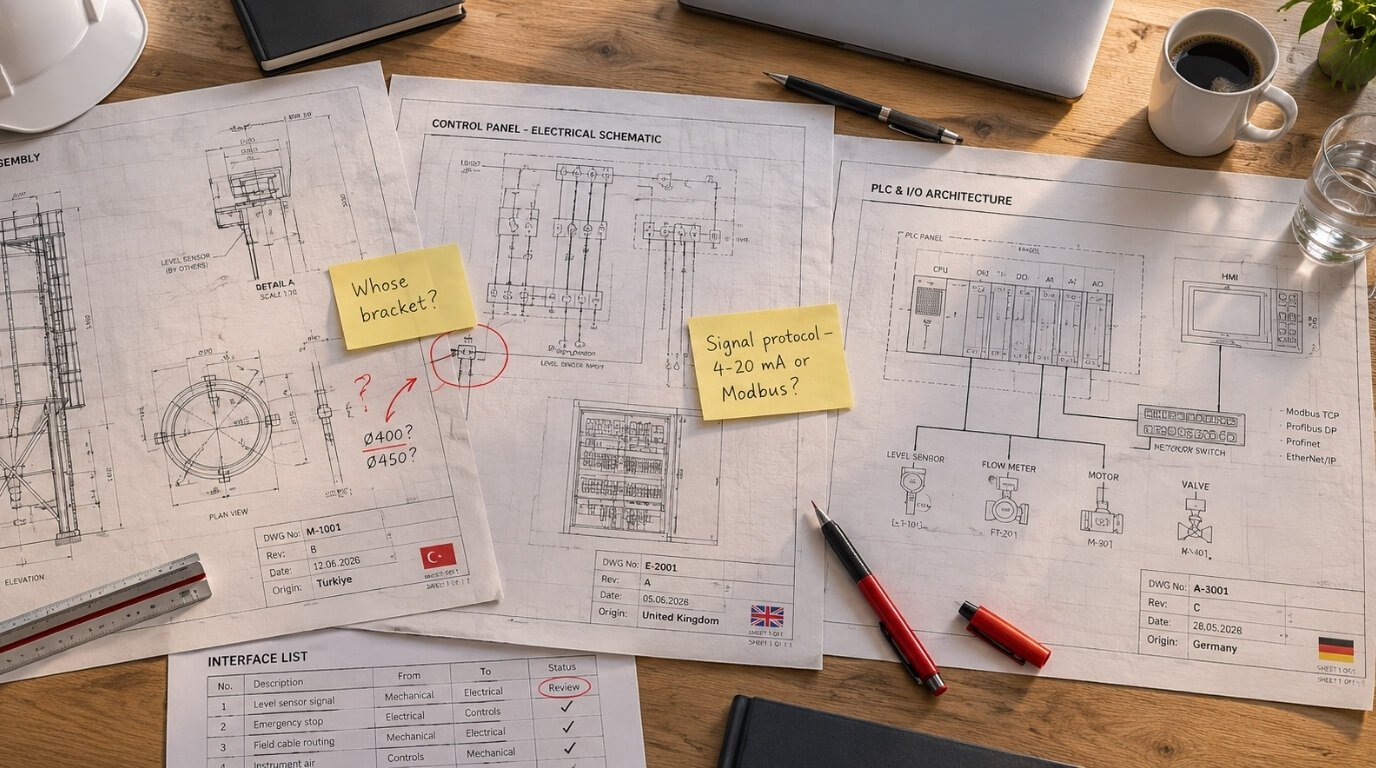
The equipment arrived on time. The civil work was finished. Two of the three suppliers are ready to commission.
Nothing has moved for weeks.
Ask anyone involved and you get a reasonable answer. The electrical contractor is waiting on a drawing. The drawing needs a decision about a control interface. The decision needs someone who can speak for the whole line, and that person has not been appointed.
Projects rarely stall inside a scope of work. They stall in the space between two of them, where the work is real but nobody quoted for it.
This is the quiet cost of cross-border project coordination. Every supplier is performing. The project is not.
The Gap Nobody Quoted For
Every supplier writes their scope to a boundary. That is not evasion, it is how quoting works. You cannot price responsibility for a system you have not designed.
So each package arrives with a clean edge. The conveyor ends at the discharge flange. The control panel ends at the terminal strip. The steelwork ends where the equipment bolts down.
Between those edges sits a set of small jobs that belong to nobody. A bracket. A signal. A dimension that two drawings show differently. Individually none of them is a problem. Collectively they are the reason a project that is ninety per cent complete can stop moving.
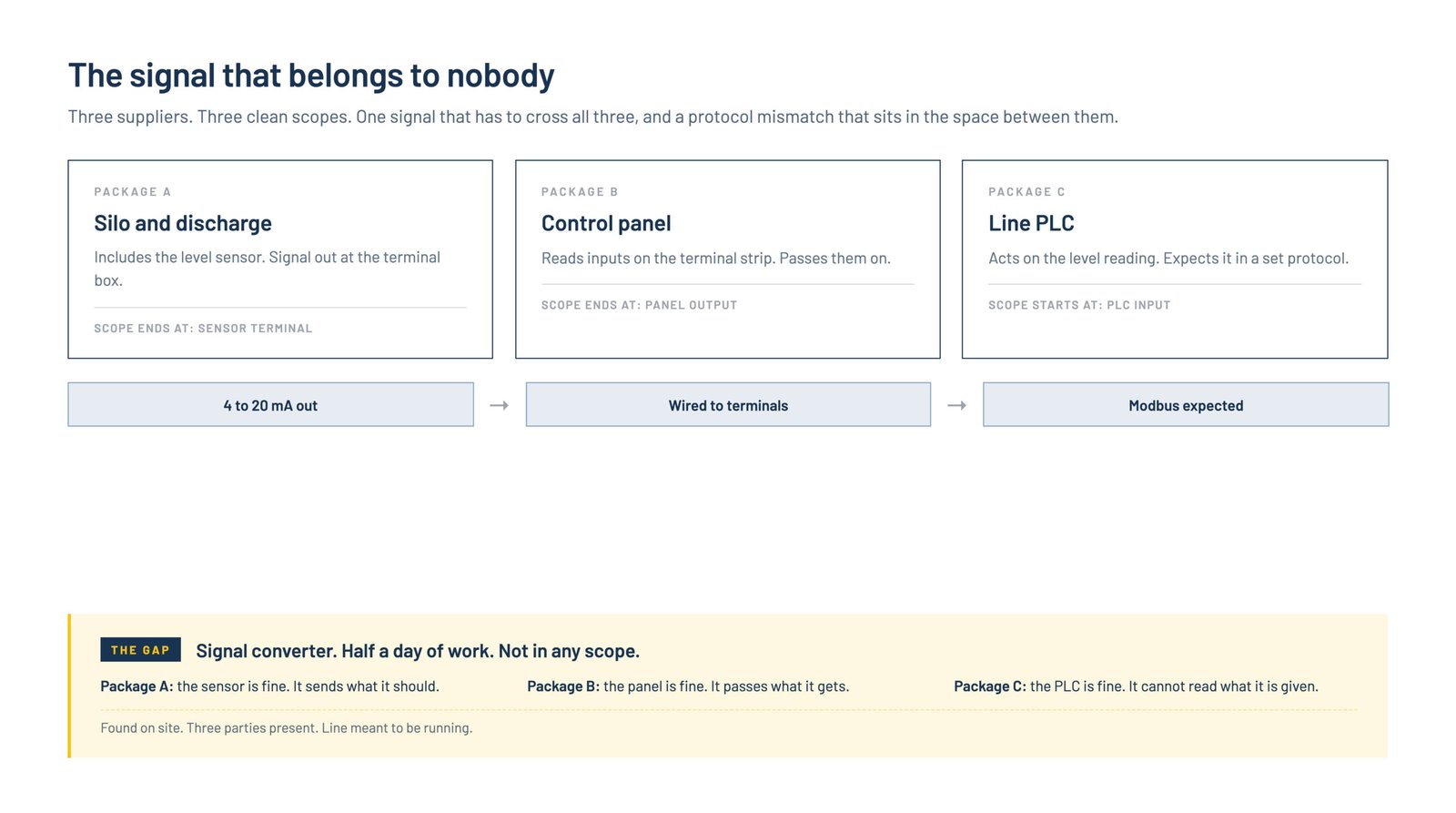
Here is what one looks like. A silo level sensor comes with the silo. The panel that reads it comes from the electrical contractor. The PLC that acts on it belongs to the line’s control supplier. It expects the signal in a different protocol from the one the sensor sends. Every party has supplied exactly what was ordered. Converting the signal is perhaps half a day of work. It appears in nobody’s scope. So it surfaces during commissioning, with all three parties on site and the line meant to be running.
The work in those gaps is usually a few days of engineering. Finding out who should do it is what takes the weeks.
Why Cross-Border Project Coordination Multiplies the Gaps
Add a border and the gaps do not just increase in number. They get slower to close.
A question that takes an afternoon between two people in the same building can take a week across a border. It has to cross a time zone, a language and two sets of standards. Not because anyone is slow. Because each exchange now needs translating, in both senses.
Three things in particular stretch:
- Standards. A drawing produced to one national standard has to be read by an installer working to another. Both are correct. Somebody still has to reconcile them.
- Site access. A supplier who can solve a problem in an hour on site needs travel, notice and sometimes a visa to get there.
- Decision authority. The person who can approve a change is often in a different country from the person who can see that it is needed.
Sequencing stretches too. Packages built in different countries arrive on their own lead times and clear customs at their own pace. The steelwork lands before the foundations are ready. The panel arrives weeks after the equipment it controls. The site absorbs the difference in storage, rehandling and idle labour. The delay is logistical rather than technical, which is exactly why it tends to sit outside every engineering scope on the project.
None of this is unusual and none of it is anyone’s fault. It is simply what distance does to a decision loop. The projects that run well are not the ones that avoid these conditions. They are the ones where somebody was made responsible for the space between the packages before the packages arrived.
Two Ways to Put Someone in Charge
Ownership does not have to mean handing over the project. In practice it takes one of two shapes, and the right one depends on where the time and the authority already sit.
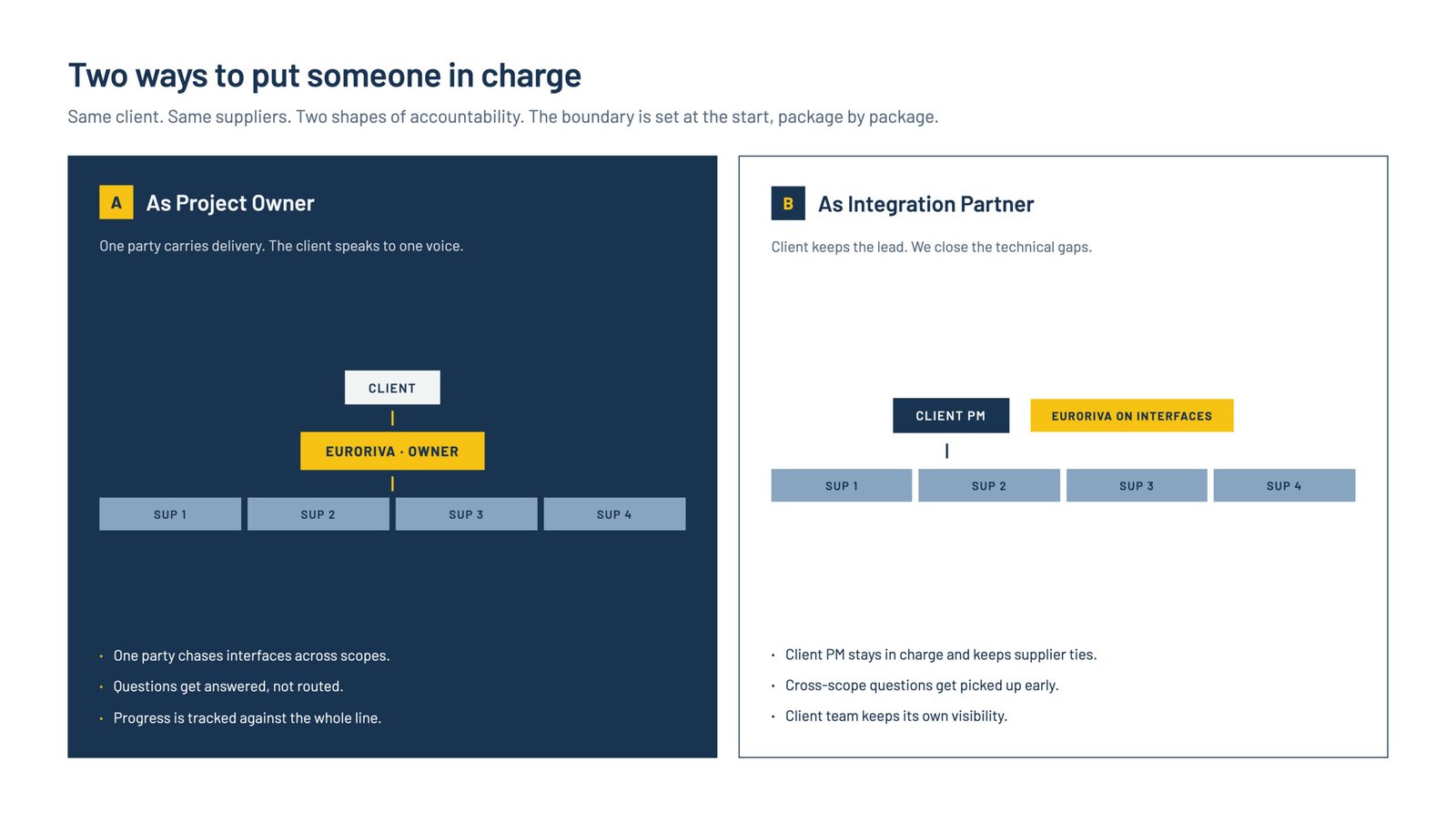
As Project Owner
We hold the coordinating role and act as the single point of accountability for delivery.
- One party chases the interfaces, so the client is not managing four suppliers in three countries.
- Questions that cross scopes get answered rather than routed.
- Progress is tracked against the whole line, not against each package separately.
As Integration Partner
The client keeps the lead. We close the technical gaps between the packages.
- The internal project manager stays in charge and keeps the supplier relationships.
- The engineering questions between scopes get picked up before they become delays.
- The client’s team keeps its own visibility rather than receiving reports about its own project.
Neither role is fixed in size. The boundary is set with the client at the start, package by package. It is normal for it to sit in different places on different parts of the same project. A client may keep the civil and building work entirely and hand over only the process line.
Two shapes, and the choice between them is rarely about capability. Most of the teams we work with could run the coordination themselves, and have done before. What they usually do not have is somebody free to do it while the rest of the plant keeps running.
What Ownership Looks Like Before Anything Goes Wrong
Ownership sounds like a title. In practice it is a short list of unglamorous habits, and they all happen early.
Somebody holds one drawing set that shows every package on the same layout. Somebody keeps a list of the interfaces, with a name against each. Somebody asks, at the point of order rather than the point of installation, which supplier is bringing the bracket.
The scope boundaries that a good procurement process draws are the same boundaries a project has to manage later. Where those were written down clearly, the coordination job is small. Where they were described in a phone call, it is not.
The same is true of the questions asked at the very start. A project defined properly is a project with fewer gaps to coordinate. The interfaces were on the table before the orders went out.
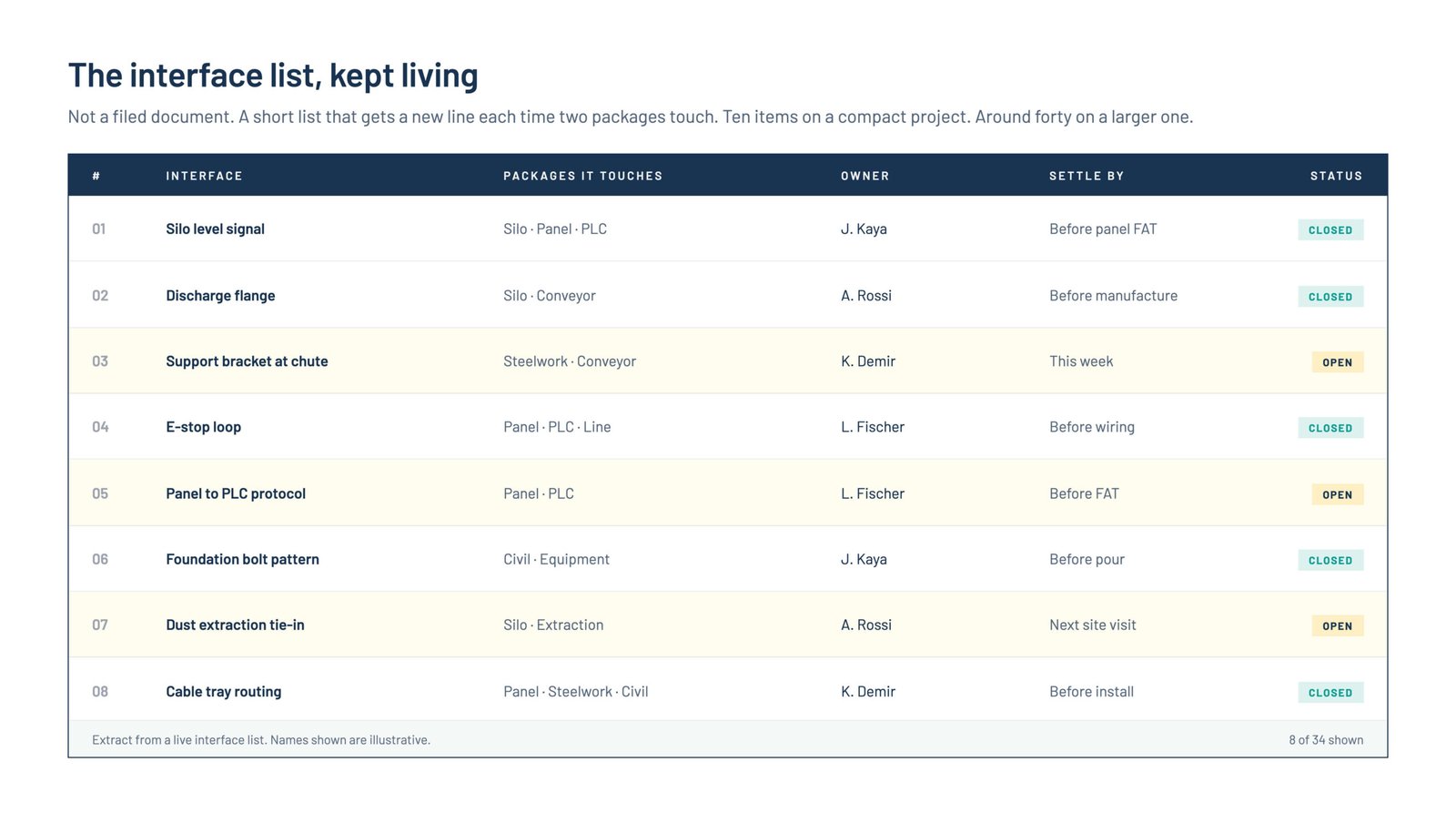
The interface list is the one worth keeping properly. Not a document produced once and filed, but a short living list that gets a line added every time two packages touch. Ten interfaces on a compact project, perhaps forty on a larger one. Each with a name against it and a date by which it has to be settled.
None of this prevents every delay. Equipment is late, weather happens, a motor arrives damaged. What it prevents is the particular kind of delay where nothing is wrong and nothing is moving.
None of this prevents every delay. Equipment is late, weather happens, a motor arrives damaged. What it prevents is the particular kind of delay where nothing is wrong and nothing is moving.
WHERE WE FIT
This is what our Turnkey Project Support service is built for. We can take it on as Project Owner, coordinating the suppliers and carrying one point of accountability for delivery. Or as Integration Partner, where your team keeps the lead and we close the technical gaps between packages.
Both start the same way, with Project Scoping and Feasibility. That is where the interfaces get named, while they are still easy to name. Supplier Coordination and Project Delivery, or Technical Coordination and Integration Support, then follow depending on which role fits.
We work across the UK, Europe and Türkiye, which is usually where the distance in these projects sits. That work sits inside our Turnkey Project Support service.
Frequently Asked Questions
One named party with authority across every package, appointed before the orders are placed. It can be someone inside the client’s team or an external coordinator. What matters is that the role covers the space between the scopes, because that is where multi-supplier projects stall.
An integration partner works alongside a client’s own project manager and takes responsibility for the technical gaps between supplier packages. The client keeps the lead and the supplier relationships. The integration partner handles the engineering questions that cross scope boundaries.
Usually because a decision that crosses two scopes also crosses a time zone, a language and two sets of standards. Each exchange takes longer, so small interface questions stay open for weeks. The delay comes from the loop, not from any one party being slow.
Planning a Project With Several Suppliers?
You have a project with more than one supplier, and you can already see where the gaps will be. We would be glad to talk it through. Tell us the scopes, the countries involved and where you are in the process.