No One Will Tell You Their Own Product Is Wrong for You
Engineering & Process Support
13 September 2026
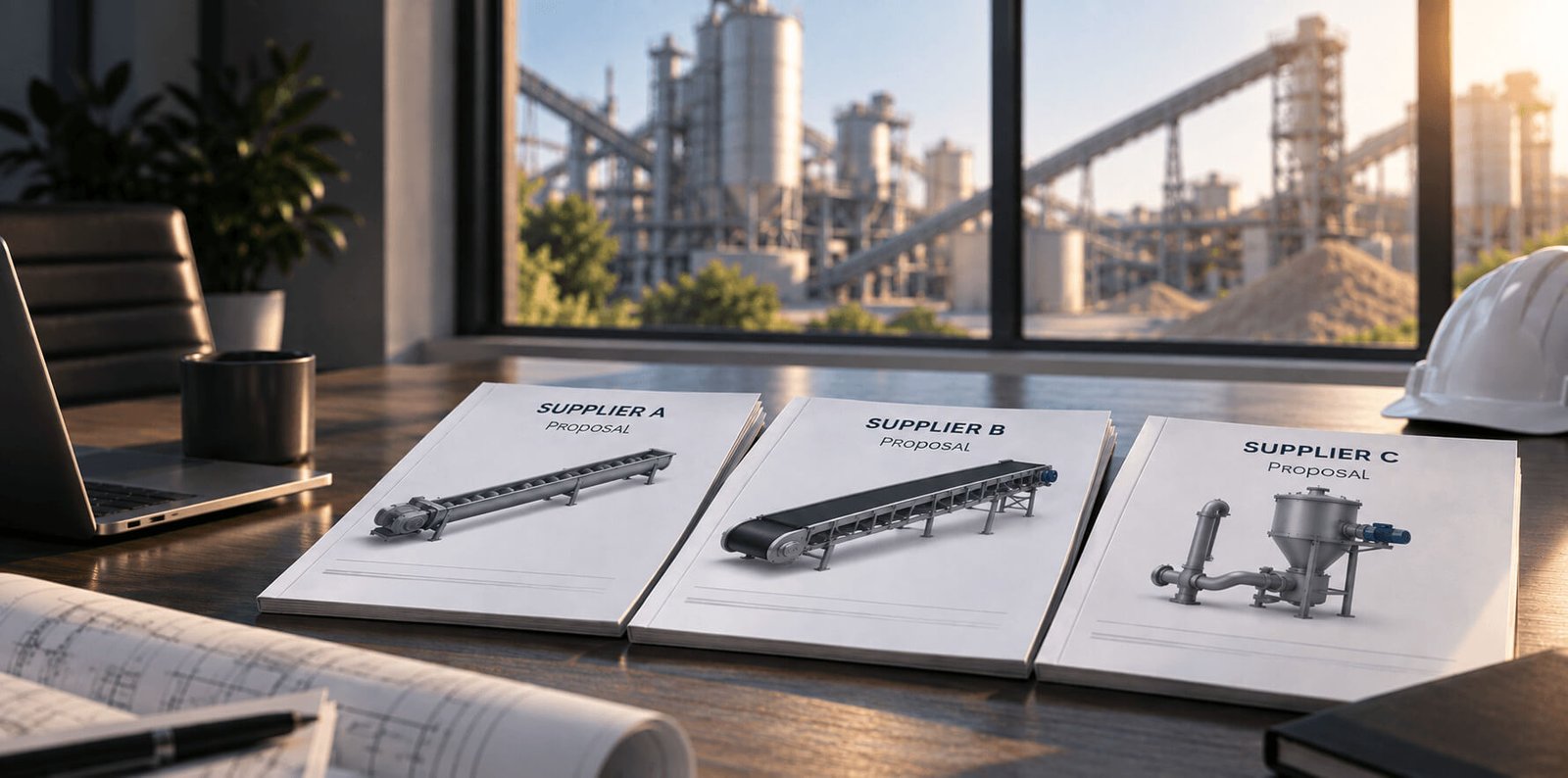
Three suppliers have sent proposals. Each one is thorough. Each one recommends the equipment that supplier happens to make.
Nobody here is being dishonest. The engineers who wrote those documents know their own machines properly, and every one of them has answered the question in front of them.
That is the trouble with most vendor selection criteria. They get written after the shortlist exists. By then the decision that mattered has already been taken, quietly, by whoever drew up the list of who to ask.
A supplier’s engineer will tell you the truth about their own equipment. Comparing one category of equipment against another sits outside that scope. That is not dishonesty. It is the shape of the question they were asked.
The gap is structural. It sits in who you asked, not in what they answered.
Why the Shortlist Decides the Answer
Ask three screw conveyor manufacturers how to move your material and you will get three screw conveyors. Each will be properly specified. Each will be sized for the duty you described.
What will not come up is whether a screw conveyor suits a damp, cohesive material at all. That question was settled before anyone picked up the phone. It was settled when the shortlist was drawn.
Take a damp recycled wood chip. It flows well enough in July and bridges in February. A screw feeder will move it, right up until the morning it does not, and then someone is standing on a platform with a bar. A belt or another conveying method might have handled the variability better. That option was never assessed, because the enquiry began with screw conveyor suppliers. Nobody was wrong about their own machine.
This is not a failure of diligence. Comparing three proposals carefully is diligence. The difficulty is that careful comparison of three answers cannot tell you whether the question was right.
Most teams already know this. What they usually lack is not the insight but the time, and a written requirement to hold the proposals against.
Vendor Selection Criteria Worth Applying Before the Shortlist
None of these are difficult. They are simply easier to apply early, while the list of suppliers is still open.
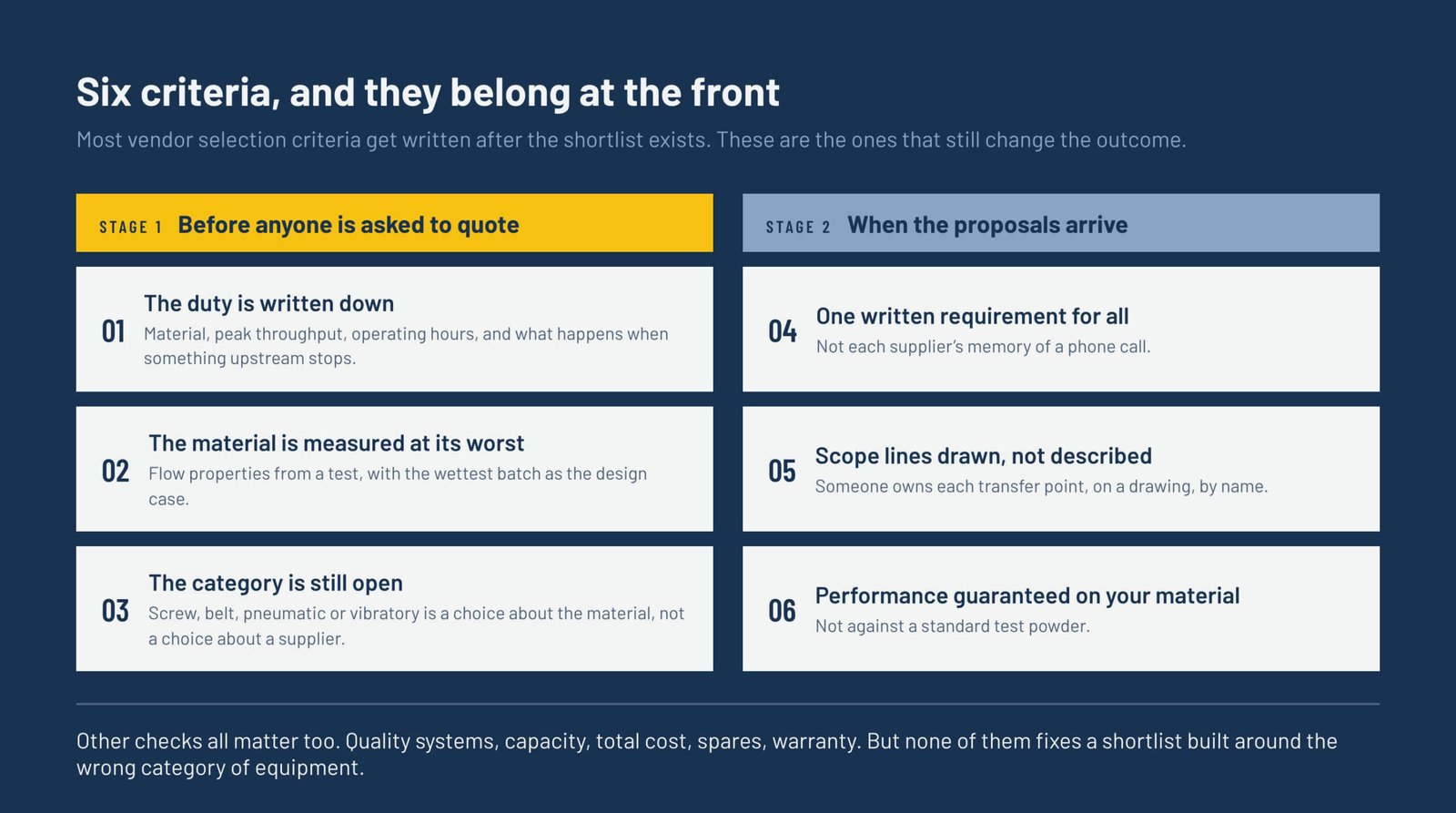
Before anyone is asked to quote
- The duty is written down first. Material, peak throughput, operating hours, and what the system has to do when something upstream stops.
- The material has been measured at its worst, not described at its average. Flow properties from a test, with the wettest batch as the design case.
- The category is still open. Screw, belt, pneumatic or vibratory is a decision about the material, not a decision about a supplier.
When the proposals arrive
- Every proposal answers the same written requirement, not each supplier’s recollection of a phone call.
- Scope boundaries are drawn rather than described. Someone owns each transfer point, on a drawing, by name.
- Performance is guaranteed against your material, not against a standard test powder.
Six questions, and they are the opening ones rather than the whole list.
Vendor qualification covers a good deal more. Safety and regulatory compliance, supplier quality systems, delivery capability and manufacturing capacity. Financial stability, total cost of ownership and energy consumption. Maintainability, access and the availability of critical spares. Warranty and contractual remedies, and environmental requirements. Where a control system is involved, add cyber security and controls support.
These are not the only criteria used to qualify a vendor. Every one of them matters, and most procurement teams already run them well. But none of those checks can correct a shortlist built around the wrong category of equipment.
The Question That Sits Outside a Supplier's Scope
A good supplier will tell you a great deal. How their machine behaves at the edge of its range. Where it wears. What it needs in the way of headroom and access. On their own equipment, their knowledge is deeper than anything an outside party will bring.
What sits outside their scope is the question above it. Is this the right category of equipment for this material?
A supplier is not placed to answer that neutrally. A full answer sometimes means recommending a machine they do not sell. Occasionally one does exactly that, and it is the most credible thing a supplier can say. But it cannot be the basis of a procurement process. You cannot build a decision on the hope that someone will argue against their own order book.
So the question has to be answered before the suppliers are involved, by someone whose scope includes it. That means someone looking at the process rather than at a product. The distinction is not about trust. It is about what each party has been asked to be responsible for.
What a Proposal Leaves Out, and Why
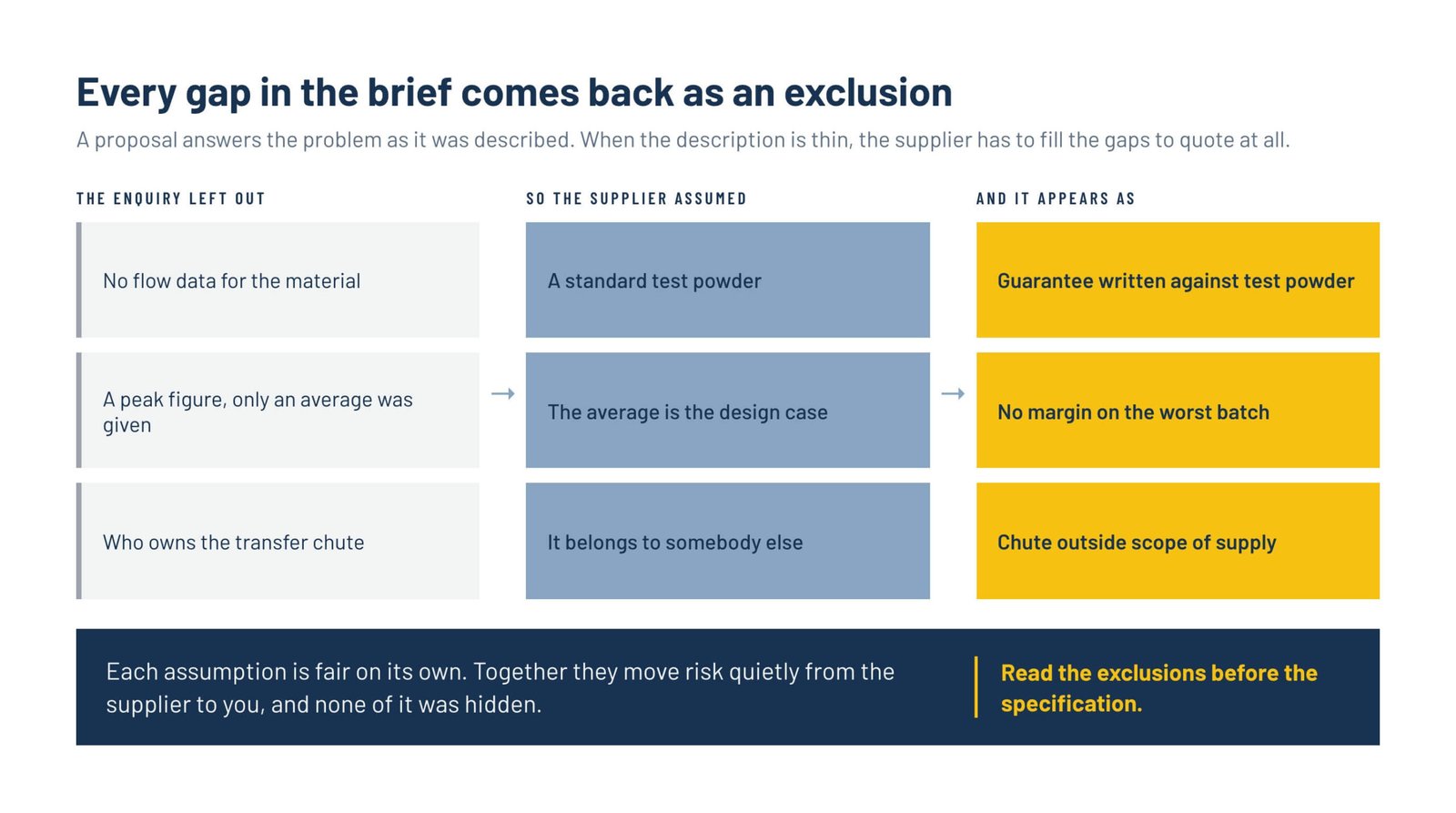
A proposal is an answer to a described problem. When the description is thin, the supplier has to fill the gaps to quote at all.
They fill them the way any competent engineer would, by assuming the conditions their equipment handles well. That is not a trick. It is the only way to respond to an incomplete brief.
So exclusions appear. The transfer chute sits outside scope because nobody said whose it was. The guarantee is written against a standard test powder because no flow data came with the enquiry. The throughput figure is an average because an average is what they were given.
Each of those is reasonable on its own. Together they move risk quietly from the supplier to you, and none of it was hidden. It was written down, in the part of the document that gets skimmed.
So read the exclusions before the specification. Exclusions tell you what the supplier believed they were not responsible for, which is a faster route to the gaps than any technical section.
Three Proposals, Three Different Assumptions
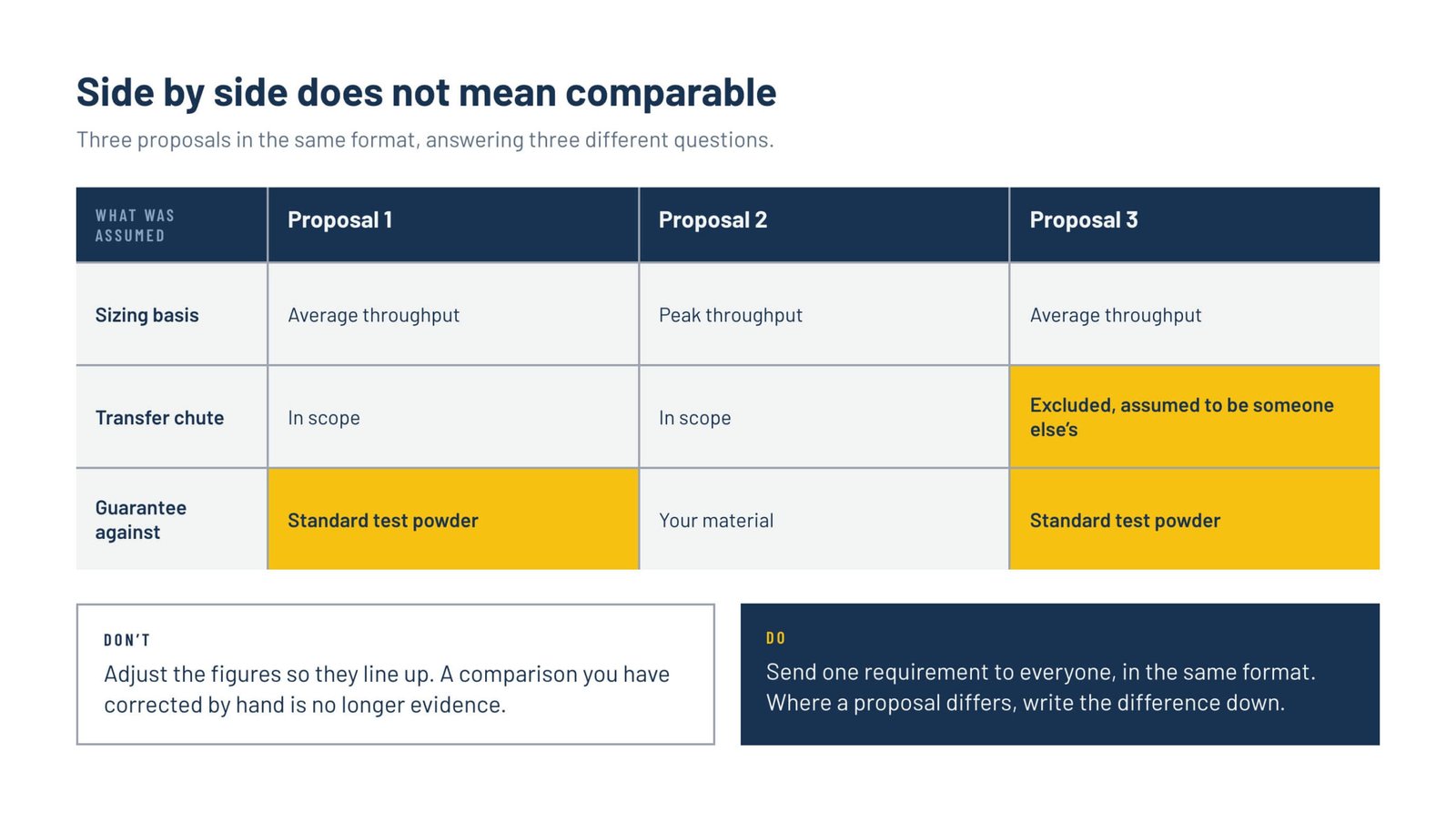
Even with a strong shortlist, the comparison itself usually goes wrong in the same way.
One proposal is sized on average throughput. Another is sized on peak. The third has excluded the transfer chute, because the supplier assumed it belonged to somebody else. On paper the three sit side by side, which makes them look comparable. They are three answers to three different questions.
Adjusting the figures to make them line up is where the real error creeps in. A comparison that has been corrected by hand is no longer evidence. It is an opinion with arithmetic attached.
The alternative is dull and it works. Write one requirement. Issue the same document to every supplier. Ask for proposals against it, in the same format. Where a proposal deviates, record the deviation rather than adjusting for it.
The questions that shape that requirement are the same ones worth asking before anything is ordered. Answer those first and the comparison mostly writes itself.
WHERE WE FIT
This is what our Process Design, Equipment Specification and Vendor Sourcing work is built for. We write the requirement before anyone is asked to quote against it, then run the comparison on equal terms with the reasoning written down.
We do not manufacture anything and we hold no agency for a supplier, so the shortlist gets drawn from what suits the duty.
Most of the teams we work with have done this before and know exactly what they are looking at. What they want is someone to hold the requirement steady while the proposals come in. That work sits inside our Engineering & Process Support service.
Frequently Asked Questions
Start with a written duty covering the material, the peak throughput, the operating hours and what happens when the line stops. Then compare every proposal against that one document rather than against each other. The criteria that decide the outcome are the ones set before a shortlist exists.
Send every supplier one written requirement and have them all quote against that, rather than against a conversation. Where a proposal differs in scope, record the difference instead of adjusting the numbers. A comparison is only fair when every proposal is answering the same question.
A supplier can advise in depth on the equipment they manufacture, and that knowledge is worth having. But some decisions involve comparing different categories of equipment. There, an independent assessment of the process gives a more neutral basis.
Specifying Equipment for a New Line?
If you have a requirement taking shape and want it settled before the proposals arrive, we would be glad to talk it through. Tell us the material, the throughput and where you are in the process.