Looking for a UK Distributor May Be the Wrong Question
Market Entry & Representation
21 October 2026

The decision to sell into the UK usually arrives as a search. Find a distributor. Sign an agreement. Start shipping.
It is a sensible instinct, and for some products it is the right one. For technical equipment it often leads to months of polite meetings that go nowhere.
The reason is rarely the distributor. It is that UK market entry gets treated as a question about who to appoint. For industrial equipment that is the last question, not the first.
A distributor is a route to market, not a reason for anyone to buy. Work out what has to happen before, during and after a UK customer buys your equipment. Then work out who will do each part. The right entry model usually picks itself.
What a Distributor Is Genuinely Good At
A distributor holds stock, carries a portfolio and already has the relationships. For a product that is understood on sight, that combination is hard to beat. The buyer knows what they are ordering. The distributor knows who wants it. The sale needs little explaining.
The economics follow from that. A distributor takes a share of each sale and earns it by moving volume across many lines. Attention naturally flows to the lines that move.
That is not a criticism. It is the model working as designed. A distributor who gave every product the same effort would be letting their own business down.
The difficulty appears when your equipment is not one of those lines. A machine specified for one material sells in small numbers. Every order starts with a technical conversation. That is not the pattern the model is built around.
Picture a manufacturer who appoints a capable distributor and waits. The enquiries that come back are for the catalogue items, the spares and the standard sizes. The engineered line, which was the reason for entering the market at all, never comes up. Nobody has done anything wrong. The distributor sells what their customers ask for, and those customers did not know to ask.
Why Technical Equipment Behaves Differently
A capital purchase is not really a purchase. It is a decision somebody has to defend internally.
The buyer needs to know how the equipment behaves with their material, not the demonstration material. They need to know who answers when something does not work in week one. They need to be able to name a person in their own time zone. Someone who will still be reachable once the order is placed.
Those questions are engineering questions wearing commercial clothes. A distributor can pass them back to you and wait. By the time the answer returns, the buyer has moved on to the option that could answer in the room.
This is the same gap that swallows conversations that started well at a trade show. The interest was real. Nobody was placed to carry it forward at the moment it mattered.
One clause worth reading twice
Exclusivity ties a territory to one party for a fixed term. It is a fair request when a distributor is putting stock and people behind the line. Refusing it outright can lose you the better partners.
It becomes a problem when the line turns out not to move and the territory stays committed anyway. If exclusivity is on the table, tie it to something measurable. Tie it to a term you could live with being wrong about.
The Question Worth Asking First
Before choosing a model, write down what a UK buyer will need to check before committing. Then note who is going to satisfy each item.
The order of that exercise matters. Start with the equipment. Then the buyer who has to sign for it. Then whatever makes that buyer hesitate. What has to exist locally follows from the hesitation. The model is what you choose last.
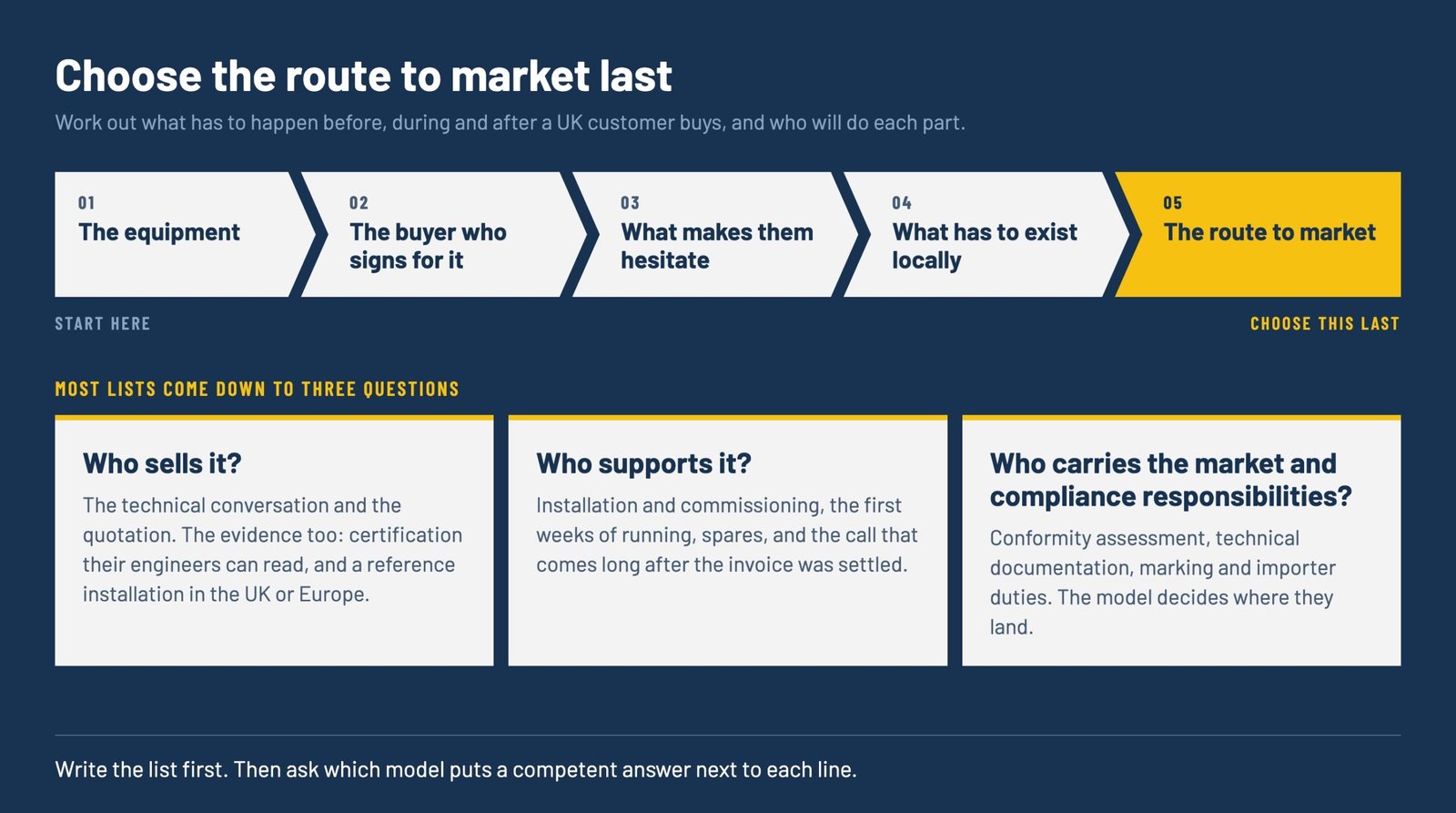
Most lists come down to three questions.
Who sells it? Somebody has to run the technical conversation that happens long before an order exists. Who answers a question about your material rather than the demonstration material. Who prepares the quotation. Who the buyer can name when their own manager asks. The evidence sits here too. That means certification their engineers can read. It also means a reference installation in the UK or Europe on a similar duty.
Who supports it? Someone has to install it, commission it and see it through the first weeks. Someone has to supply spares. And someone has to take the awkward call long after the invoice is paid. When equipment is specified rather than picked from a catalogue, this is often what the buyer weighs most. A model that wins the order and then goes quiet has not solved very much.
Who carries the relevant market and compliance responsibilities? Depending on the product, selling into the UK brings legal duties. The law decides who holds them, not the agreement. Conformity assessment, technical documentation and marking all have to land with someone. So do the duties of whoever acts as importer. The model you choose decides where. Settle it before anyone drafts an agreement.
A buyer uses the same criteria to choose between suppliers. You are seeing them from the other side of the table.
Write the list first. Then ask which model puts a competent answer next to each line. That is a different exercise from asking who might be willing to represent you. It tends to produce a different answer.
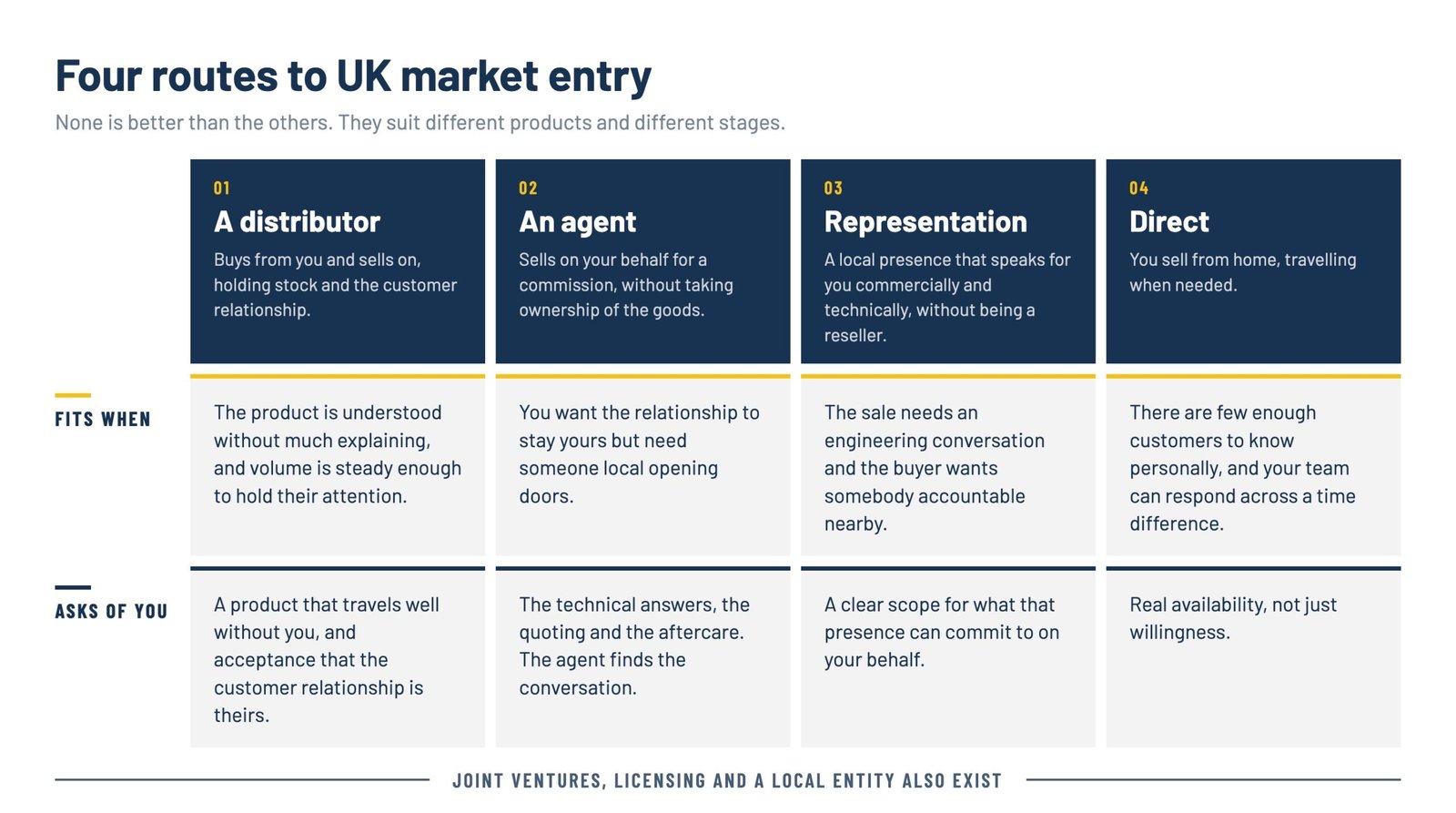
Four Routes to UK Market Entry, and What Each Asks of You
None of these is better than the others. They suit different products and different stages.
A distributor
Buys from you and sells on, holding stock and the customer relationship.
- Fits when the product is understood without much explaining, and volume is steady enough to hold their attention.
- Asks of you: a product that travels well without you, and acceptance that the customer relationship is theirs.
An agent
Sells on your behalf for a commission, without taking ownership of the goods.
- Fits when you want the relationship to stay yours but need someone local opening doors.
- Asks of you: the technical answers, the quoting and the aftercare. The agent finds the conversation. You still have to carry it.
Representation
A local presence that speaks for you commercially and technically, without being a reseller.
- Fits when the sale needs an engineering conversation and the buyer wants somebody accountable nearby.
- Asks of you: a clear scope for what that presence can commit to on your behalf.
Direct
You sell from home, travelling when needed.
- Fits when there are few enough customers to know personally, and your team can respond across a time difference.
- Asks of you: real availability, not just willingness. Most of the strain lands on whoever answers the phone.
These four are not the whole map. Joint ventures, licensing and setting up a local entity all exist. But most companies entering the UK choose between these four. Too often they choose by default, not on purpose.
What Usually Decides It
In practice the choice comes down to four things, and none of them is about ambition.
How technical the sale is. The more engineering that sits between interest and order, the less a pure resale model does for you.
What happens after the order. Commissioning, support, spares and warranty questions all arrive after the sale. And they keep arriving. Ask who can win the order and you get one answer. Ask who will still pick up the phone once the equipment is running, and you may get another.
Where the attention will come from. Whoever you appoint has other work. That is not a flaw, it is arithmetic. The model has to survive the fact that nobody thinks about your product as often as you do.
How reachable you can realistically be. A supplier who can answer a technical question the same working day does not need much local presence. One who cannot, does.
Most of the manufacturers we work with have already weighed all of this. What they usually lack is not the judgement. It is somebody in the market to test it against before the agreement is signed.
WHERE WE FIT
This is what our Market Entry & Representation service is built for. The Market Entry Launch Pack is where the entry model gets chosen deliberately. The test is what the market will ask of you, not what is quickest to arrange.
Where the answer is representation, Rep-as-a-Service puts a named person in the market. They hold both halves of the conversation, the commercial and the engineering.
We work across the UK, Europe and Türkiye, and we have sat on both sides of this decision. That work sits inside our Market Entry & Representation service.
Frequently Asked Questions
No. A distributor is one of several routes. It suits products that sell without much technical explanation. For capital equipment there is usually an engineering conversation in front of each order. An agent, a local representative or direct selling often fits better.
The four common ones are a distributor, an agent, local representation, and selling direct. Joint ventures, licensing and setting up a UK entity also exist. The right choice depends on three things. How technical is the sale? Who will support the equipment afterwards? And where do the market responsibilities sit?
That depends far more on the model than on the market. You can appoint a distributor quickly. But the first orders follow the distributor’s own cycle. Direct relationships take longer to build. They tend to be more predictable afterwards. Anyone quoting you a fixed timeline is describing their process rather than your market.
Thinking About How to Enter the UK Market?
If you are weighing up how to sell into the UK, we would be glad to talk it through. Better to test the model before an agreement is signed. Tell us what you make and who buys it today.